
VINCE SCULLY | from Life Sherpa
VINCE SCULLY | from Life Sherpa
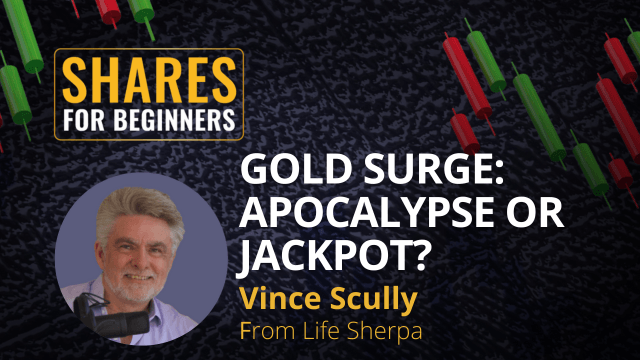



My guest this week is Vince Scully from LifeSherpa, a returning friend of the podcast and expert on portfolio strategies. We explored gold’s powerful role in smoothing long-term returns and acting as a hedge against market turbulence which is especially relevant given its sharp rise alongside silver.
Gold has been on a tear, with queues forming outside bullion dealers and plenty of chatter about whether it’s finally time to sell. Vince, however, is clear: gold’s primary job in a portfolio is insurance, not speculation. LifeSherpa has held gold as the first defensive allocation for over a decade, and Vince has personally owned it since the Global X Gold ETF launched around the GFC.
He pushes back firmly on the popular “currency debasement” narrative that's all over social media. In his view, we’re not seeing 1970s-style inflation; modern economies with independent central banks don’t default on debt issued in their own currency, and government deficits largely create private-sector wealth. Instead, Vince sees the real driver as "de-dollarization". Growing skepticism about U.S. governance and the dollar’s status as the ultimate safe-haven asset is pushing investors toward alternatives including gold, even though it’s priced in USD.
For practical exposure, Vince recommends physical-backed ETFs over physical bars or miners. He favors Global X GOLD (allocated physical gold stored in London vaults) for its security, though the newer GXLD offers a lower management fee. PMGOLD (Perth Mint) is slightly cheaper but unallocated and backed only by the WA government’s promise. Vince prefers true allocated gold even at a small cost premium. Physical gold sounds appealing, but storage, insurance, liquidity, and buy/sell spreads make ETFs far more practical for most investors.
We discussed silver’s parallel run driven partly by industrial demand in solar panels and electronics, and the gold-silver ratio as a potential trading signal. Vince pointed to gold’s track record in major crises (2008, early 2020, 2022), where it rose while equities and bonds fell, providing real ballast.
In portfolio construction, Vince uses gold as the initial step into defense: a 10% allocation in a 90% growth portfolio before layering in bonds. It offers no yield, but it significantly dampens volatility and helps investors avoid panic-selling during drawdowns.
The conversation naturally turned to Australia’s commodity exposure. With BHP recently touching $50 and shortages emerging in copper, lithium, and rare earths, Vince sees signs of a potential super cycle that could benefit our market. Still, he reminded listeners that ASX price indexes ignore dividends (about 35% of total returns) and franking credits, so headline numbers understate real performance.
For investors who prefer a hands-off approach, Vince highlighted LifeSherpa’s risk-targeted portfolios (from $5,000 online, no advisor needed). These have outperformed major public super funds after tax and fees over the past decade—largely thanks to thoughtful asset allocation, including gold as a core defensive holding and active micro-cap exposure to capture small-company premiums.
TRANSCRIPT FOLLOWS AFTER THIS BRIEF MESSAGE
Level up your investing with Sharesight, Investopedia’s #1 portfolio tracker for DIY investors. Track 240,000+ global stocks, crypto, ETFs and funds. Add cash accounts and property to get the full picture of your portfolio – all in one place. Ditch the chaos, track like a pro! Sharesight makes investing easy. Save 4 months on an annual paid plan at THIS LINK
Portfolio tracker Sharesight tracks your trades, shows your true performance, and saves you time and money at tax time. Save 4 months on an annual paid plan at this link
Disclosure: The links provided are affiliate links. I will be paid a commission if you use this link to make a purchase. You will receive a discount by using these links/coupon codes. I only recommend products and services that I use and trust myself or where I have interviewed and/or met the founders and have assured myself that they’re offering something of value.
EPISODE TRANSCRIPT
Phil Muscatello: G' day and welcome back to Shares for Beginners. I'm Phil Muscatello. What is the investment that will smooth out your portfolio returns over the long term? And why do you need to think about the oldest form of money hoarding as a key to your wealth in the future? Joining the podcast again and friend of the podcast is Vince Scully. Hello, Vince.
Vince Scully: G', day, Phil. It's great to be back. And gold is one of my favorite favorite assets.
Phil Muscatello: It's a nice asset, but gee, it's on a tear lately along with silver as well. I wake up at all sorts of times of day because I've got a tiny holding in a couple of silver stocks that I'm looking at and just watching it just go up and up and up through the roof. But yeah, what are you seeing in, uh, this kind of thing?
Vince Scully: Yeah, I mean that's an interesting one that we've been long term holders of gold. So we've had gold in lifeshipper portfolios for more than a decade and, and it's in fact our first step into the defensive realm. And I personally have been a holder for as long as what's now the Global X Gold ETF has been listed, which takes us back to the gfc. But many people go, well, why are you holding gold? Is now the time to sell? And that's to miss the point about why gold. You know, you see the queues outside, uh, ABC bullion on Martin Place, everyone's talking about it. And so the question goes, well, actually, is now the time to sell? And people were asking that question three months ago when the gold price was 20, 30% lower. And certainly it's gone a long way.
Phil Muscatello: And there was a bit of a turnaround in the price as well, wasn't there? And you know, everyone thought, ah, those idiots were queuing up, but now they're, they're laughing on the other side of their face.
Vince Scully: Yeah, so it dipped off its October high and then went on a tear and of course silver's now following. So silver's doubled since late last year and only in January.
Phil Muscatello: So it's amazing. What do you think the reasons for this? I mean there are some pundits out there who talk about currency debasement, that inflation is basically eroding the value of our money and these are the only assets that will hold the value. And against the backdrop of rising bond yields as well, there seems to be pointing to continued inflation and currency debasement.
Vince Scully: Yeah, I must admit I'm a bit confused about the uh, use of the word debasement trade. That's more a uh, de. Dollarization trade. So debasement implies that the value of the currency is being eroded. Well, anyone who understands how economies work know that that's simply not true. We do have, you know, steady inflation and of course you need some inflation to stimulate an economy. But you uh, know, these are not what any, by any stretch of the imagination anyone would call inflationary times. Yeah, anyone with a memory of the 70s and 80s knows what inflation looks like. And a government that is in that issues in its own currency and is in control of its currency through an independent central bank cannot default. And a government deficit is simply the flip side of a uh, private sector uh, surplus. And the only place private sector wealth comes from is government sector, uh, deficits. So every debit has a credit in a m. Modern economy. That wasn't necessarily the case pre 71 but today if you renamed the government debt clock as uh, the private sector wealth clock, we'd all be encouraging the government to turn the printers on. And it will only create inflation to the extent that it's demanding resources that are in short supply in the economy. Now having said that, ah, 6% deficits in the U.S. uh, I wouldn't necessarily say problematic but shouldn't be happening in a time, in a positive economic time. There's no real need for it. But you know, I remember when I was at business school in 1986, which was 40 years ago this year, everyone was exercising themselves about what they call the twin deficit at the time in the US it was going to bring the world to an end. Well actually there's been two surpluses in the 40 years since and the world hasn't ended and shows no signs of ending. And the economy is bigger and better than it's ever been before. We
00:05:00
Vince Scully: may not have the uninterrupted growth that we did in the 50s and the peace dividend may very well be coming to an end. But nonetheless these have been extraordinary times both in economies and in the markets. And the last 15 years have seen probably the highest real growth in equity prices in certainly the longest uninterrupted growth in equities for a long time. So I don't buy this debasement story. I think there is a de dollarization story that the US is losing part of its credibility as the safe store of wealth. There used to be a saying that m what you buy, you just stash it in US Dollars. So US equities, gold, US dollar bonds, US Dollars. And that, uh, currency would take care of itself over time. Now, that's possibly not. I mean, the Australian dollar is up nearly 10% over the year against the US dollars, which obviously doesn't help the gold story. But I'm not a debasement fan. I don't think that's the story here. I think it's a de dollarization story.
Phil Muscatello: Okay, uh, how does that work? I mean, what are the mechanics of that?
Vince Scully: Well, historically, well, certainly since the post Second World War, even post First World War, the world reserve currency has been the US dollars. So that in fact post World War II, pre 1971. So from what's that, nearly 20, 26 years, most global currencies were tied to the US dollar, either directly or indirectly. And so the US dollar was considered the benchmark. So when times got tough, you ran.
Phil Muscatello: To the gold standard, so to speak.
Vince Scully: Exactly. And that's been the case for a while now. People, I think, are skeptical about US governance and how well the economy is being managed. Now, without getting too political, I don't think you've got to be Einstein to work that one out. And so the world's going well, actually, maybe the US dollar isn't the safest place to be. So question is, well, where do I go? For some time, the euro was potentially a new world reserve. The UK has lost its reserve status probably since the end of the First World War. And yuan's not quite there yet. So, uh, it's not quite. Tina. There is no alternative, but it's just, uh, a little bit at the edge. Part of that's going to gold. But of course, gold's priced in US dollars, so there's some interesting dynamics there. And if you just look at the behavior of the US Dollar, it's been on a fairly steady slide for just over a year. I, um, don't need to tell you what happened a year ago. And it's difficult to see other than waiting three years, what's going to turn that around.
Phil Muscatello: So how should investors become exposed to gold? Are we talking physical? Are we talking miners, ETFs. And yeah, we've got that theory. Yeah, there is that theory that you buy gold miners because they're leveraged. You know you're going to get triple the return from investing those. That is the story, of course.
Vince Scully: Yeah. So that's a distinction between someone wanting to trade the gold story and someone wanting to buy the hedging or insurance benefits of gold. So if you're simply trying to take a position on the gold graph going up to the right, then gold miners make up uh, perfect sense, especially miners close to the lower end of the cost, uh, curve. So that is lower cost miners. And Australia has got quite a few very good low cost miners. And a gold mine is in effect a call option on gold at the cost of taking it out of the ground. It's not quite that perfect because there's a, there is a cost of shutting it down or putting it in mothballs. So you will still produce gold even if the sale price is below your cost of extraction for a small period. But obviously if you can pull it out of the ground at 300 or $400 and sell it into the market at 5,000 U.S. well that's a great trade. You do that all day, every day. Obviously there's physical limitations on how fast you can do that around the design of your mine and your processing plant, but that's a way to play that gold story. The reason you don't get the same hedge benefits is you're also buying equity exposure at the same time. So the earnings of that miner is priced at an equity type multiple and so you're exposed to general movements in the market multiples. So if you want
00:10:00
Vince Scully: to buy the insurance and hedging benefits of gold, which is why they're in our portfolio and why we put it in the defensive category, whereas you'd put a mine gold miner in the growth category. It's an important distinction. There is you want physical gold and the easiest and cheapest way of doing that is to buy a, an exchange traded product. The most popular in Australia is the Global X Gold, which is technically not an etf, but I think that's a subtlety that's immaterial to most people. But it's the IT and PM Gold, which is the Perth Mint equivalent. The Perth Mint one is slightly cheaper in terms of MER M but it's not allocated gold. It's effectively a right to call for gold and that right is in effect backed by the West Australian government which is AAA rated. So it's a fairly solid substitute we prefer that true allocated option even if it is slightly more expensive.
Phil Muscatello: Vince, Vince, when you're talking about that with the um, Gold ETF or ETP as you're making a little nuanced distinction there with, that's backed by physical gold in vaults in London, isn't it?
Vince Scully: Correct? Yeah.
Phil Muscatello: That's what you're talking about here.
Vince Scully: Yeah, yeah, yeah. So each bar has an index number and so when a new unit in or new, technically it's a preference share but a new unit in the gold EDP is created. There is a physical bar in a vault in the bank of England or underneath the bank of England in London. And if you're a sufficiently large investor, you can go and call for your bar to be delivered to you. That's the most secure and that's audited every periodic and the bars are all numbered.
Phil Muscatello: Track your investments like a pro. Sharesight is Investopedia's number one portfolio tracker for DIY investors. Simplifying your finances. Get four months free on an annual premium plan at sharesite.com sharesforbeginners and so PM Gold is a promise, is it?
Vince Scully: And yes.
Phil Muscatello: So some people, presumably, presumably the WA government could fossick around somewhere in the outback of WA and find enough gold to satisfy any kind of redemption. But there is a subtle difference there, isn't it?
Vince Scully: There is a subtle difference and I wouldn't be one to impugn the credit quality of the West Australian government. It is the highest rated state in Australia, it's got a very sound economy and its odds of default are, uh, close to zero. But Perth Mint's compliance track record is, should we say, patchy. It's been pulled up for a number of things around money laundering and various things which to me is a red flag. It's not necessarily indication that it's going to default or the West Australian government is going to default. That's not the point I'm making and I want to be very clear about that. It's just that compliance in financial services is a must have, it's not negotiable. And so a company that can't get its governance together to do the most fundamental job they have to do is one that I want to be getting something very material to consider it. And to me 20 or 30 basis points, 0.2 0.3% of funds under management is a small insurance price to pay. There is a newer, cheaper version of gold, so GlobalX have launched a second more modern product which is slightly cheaper. And if you were starting out, uh, Today to construct a portfolio you might look at that as an alternative. It's still relatively small but it's growing. But you, it's not enough to rotate out of gold into the new product. But you know for someone starting today this new global X ETF is called gxld so it's a slightly different structure. It is actually an etf. It's got a cheaper uh mei uh, largely driven by the structure. I suspect there must be a tax reason or a commercial reason why GlobalX don't restructure the old one. I haven't looked at it in great detail so but starting together, you know it's a fraction of the size of the gold and its spread is slightly higher but lower. Mercury
00:15:00
Vince Scully: cleaner, more modern structure. So someone starting today might look at that. But I certainly wouldn't be suggesting that you rotate out of one into the other.
Phil Muscatello: Well then what about physical gold? I mean some people do love hugging the shiny stuff to their chests.
Vince Scully: Yeah, I mean trading physical gold is more expensive so that costs, you have.
Phil Muscatello: To pay a haircut isn't it? And it's quite a substantial price to buy and sell it isn't it?
Vince Scully: Yeah. And obviously the um, bigger the chunk you're buying. So if you're buying a 440 ounce bar which is a lot of money or you're buying a uh, half ounce or a 1 ounce you'll pay a different price. There's less of a liquid market. You know you obviously got to find someone to buy it from you. The most obvious way to do that is to buy it through a uh, bullion dealer like a Perth Mint or an abc. Sometimes you can get them to hold it in their vault. That comes sometimes with a storage price. If uh, you store it at home you obviously have the insurance and loss risk if you're holding it in your smsf. Obviously holding it at home is a no no. And so for my money I'd be holding it in secure storage. But the cost and lack of liquidity obviously you can't sell half of your one ounce bar whereas you can sell $500 of gold. So that's why we would always look at the exchange traded products. If you want to take a trading position obviously you can look at the uh, options market but you know from a uh, portfolio insurance perspective there is no substitute for the exchange traded products for most people. Yeah, if you're an investment bank you may take a different view. And in fact there was a great trade early last year where people were buying gold in London and selling it in New York, because that gap between the two prices opened up beyond the physical cost of shipping it. And the interesting twist there, which is historical, the bars in the London market are different, uh, size and shape to the, uh, bars in the US Market. And so in order to do that trade, you take physical delivery in London, ship it to Switzerland and have it remelted down and recertified into a US Sized bar, and then ship it to the US that obviously comes with a cost, and that sort of forms a, ah, floor between the difference in the two prices. Historically they've traded very closely together, but there was a view that the tariffs might change that analysis early last year and the price spread opened up and there was this physical trade that happened to close it. So markets are generally broadly efficient in this way, and so they don't tolerate inefficiencies for very long.
Phil Muscatello: Are, uh, There any other ETFs available? I know, uh, we hear a lot about synthetic ETFs. Are there gold, synthetic ETFs, ETFs, or anything like that available?
Vince Scully: There are a handful of other ones. The big thing to watch out for if you're moving away from M. GXLD or gold is whether or not it's currency hedged and some of the other products are currency hedged. And that obviously removes part of the benefit to an Australian investor of investing in gold. And that's probably a point that's worth elaborating on, Phil, because the reason why an Australian, South African or Canadian investor for that matter, should hold gold is a different analysis than whether a US Investor, for example, should hold gold. And most people get most of their online content from US creators. And so that message gets a bit muddled. And of course our, uh, good friend Warren Buffett, a good friend of the show, always said that gold would be the last thing you'd ever want to hold. And looked at from a US Investor perspective, maybe that's not an irrational position. And the reason that matters is when markets get turbulent. Historically, investors have done two things. They flock to the US Dollar and they flock to gold, which pushes up the price of both of those against other currencies. And so if you're a US Investor, your holding US Dollars rises along with the price, uh, of your gold. So the net impact to you in your, um, home currency is lower. Looked at, however, from someone who lives or earns, spends and is taxed in a, uh, commodity currency, like a Canadian, South African or Australian investor, when markets get
00:20:00
Vince Scully: turbulent, those currencies being risk on Currencies tend to fall faster than other currencies. So though a, uh, US dollar asset rises from the perspective of one of those investors, and of course not only is gold rising in US dollars, but the value of those US dollars is rising in your home currency. So you get this double whammy effect which creates a very powerful hedge, certainly against larger movements. Whether it protects against day to day fluctuations is much less clear. But if you look at what happened in 2008, equity markets fell, gold rose. If you look at what happened in 2018, so 2020, the uh, pandemic, just about everything fell. So equities fell very strong. You know, that period from the end of February to the beginning of April was a horrendous time on just about every market around the world. And because governments reacted by dropping interest rates, bonds fell as well. Bonds fell obviously not because of interest rates, but they fell. And um, bright spot on that horizon was gold. Gold rose through that period. So, and similarly we had the same effect in 2022, we had the same effect during the Trump tariff tantrum in 2025. So it provides a very strong counter to large and especially unexpected movements. It's not so good on a day to day hedge, but for a commodity currency investor, where the currency is a good barometer of the world attitude to risk, it provides a better one. So that's why we hold it. It's our initial step into defensive. So if you want to step down from 100% growth portfolio to a 90, our first step would be a 10% allocation to gold. And then beyond that, if you step down to 80, 70, 60, 50, then you're starting to add more and more bonds and that gives you a uh, more powerful smoothing impact than bonds alone. The downside of course is that you're not getting any yield at all. So in a income portfolio it means you need to start looking for income elsewhere to offset the loss of income from this particular hedge. But nonetheless, our 90% growth portfolio still spits off high twos. You know, 2.7 to 3% in yield. And thaad, uh, gold provides a serious amount of dampening. We're not tempted by the price to crank up that allocation. We think that is to somewhat miss the point. Um, nor do we think that a US$5,000 gold price is a sell signal because of why it's in the portfolio. If you're trading the gold price, you might come to a different conclusion. And that's an important distinction as to, as Simon Sinek says, you've got to start with the why, why am I holding gold? In our case, we're holding gold as an insurance policy. And to a large extent, no matter what the price you buy insurance, if the consequence is catastrophic. And for most people, that consequence that matters is the, uh, yielding to the emotional temptation to sell. When markets get turbulent and gold provides a, uh, bit of stability that pushes that threshold further away from the likelihood of happening. If, on the other hand, you're going gold, 5,000 is going to the moon, then you probably should be buying options, futures or miners. Different trades, different rationale, which probably brings the silver story to the forefront. Gold and silver happen together geologically quite regularly. They've been, historically, they've traded very closely together that what's good for gold is good for silver. There are some technological changes that have changed that dynamic. So silver has a much higher industrial use today than it used to, about 60.
Phil Muscatello: Yeah, we're talking solar panels, aren't we here?
Vince Scully: Yeah, solar panels, electronic circuits, whole bunch of reasons. But solar obviously is the big story and that's a slightly different dynamic. But historically they have traded in a band. That ban can be illusory. You know, if you look at the most famous case being Isaac Newton when he ran the British Mint or the Royal Mint, he catastrophically got that ratio wrong and that
00:25:00
Vince Scully: effectively destroyed silver's coinage in the. Well in Great Britain as it was then, it didn't become the United Kingdom until, well, ultimately 1801, when was the Scottish one, 17 something. Oh, testing my knowledge, 1801 was the act of the Union when it became the United Kingdom. Great Britain and Ireland in those days, and now, you know, Great Britain and Northern Ireland, but he got that catastrophically wrong. And. But if you look at it since 1971, which is the. You can't really look at gold statistics pre1971 and apply the results to today meaningfully. And if you look at that period, you know, the gold silver ratios traded sort of between mostly in the 50 to 80 range. So that is the price of an ounce of gold is 50 to 80 times the price of an ounce of silver. And it's got up, got up to 100 and something in the pandemic. But more recently, as silver's gone for a run, it's plummeted. It hit 40 something the other day, which is extraordinary low. It was 60 at year end and it hit about 40 something a few days ago. So people have often used that as a trading signal, you know, so you, if the ratio falls that low, you either conclude that silver's overvalued or gold is undervalued. Undervalued, yes, that's it. Or vice versa. And so, um, people have traded that. That's not the business we're in, of course, but there's lots of people making a good living doing that. You obviously have to get that call right. And the way to manage it is you short one and go long the other. But you've got to make sure you know the direction of that trade. Which one is mispriced.
Phil Musatello: Super. Is one of the most important investments you'll ever make. But how do you know if you're in the best fund for your situation? Head to lifesherpa.com to find out more. Lifesherpa, uh, Australia's most affordable online financial advice.
Vince Scully: Foreign.
Phil Muscatello: There's also the apocalypse trade in silver because as you know, getting back to currency debasement, there are some people that you need silver in your prep locker along with all your tin goods and ammo. And that this is. You can't slice off little bits of gold, but it's very easy to turn silver into coinage and at usable currency levels. But that's just. By the way, I don't think there's many listeners that are preparing for the apocalypse just yet.
Vince Scully: But that of course was the, uh, reason we have milled edges on our coins, which again, another innovation from Isaac Newton M that the UK currency got its milled edges in an attempt by Isaac to put a halt to people rubbing off the edge and keeping the silver elsewhere. So you get similar sort of effects with other metals, platinum for example, but they're much less liquid. Liquid markets. I think GlobalX have a Platinum ETF as well. And there's certainly the basket of. There's a precious metals basket as well.
Phil Muscatello: Yeah, palladium as well. I think they've actually got palladium. Or is it part of the basket? I don't know. Either way. Yeah, they're the four main precious metals, aren't they?
Vince Scully: And of course a lot of those have more industrial uses. So every one of us has a ton of that stuff in our car because that's how catalytic converters work and slightly different dynamics. But I think the big message out of all of that is if you want to, in precious metals as a hedge, you don't want to be currency hedging it because that takes away a lot of the benefit from a, uh, Australian investor perspective. And I put Australians in the same basket as Canadians and South Africans in that context. Although the Rand obviously isn't as tradable a currency as the Australian dollar.
Phil Muscatello: So um, we've just seen, we're recording today on January 28th and this episode will be coming out on February 4th in a week's time and things can happen really quickly. But just uh, Yesterday I think BHP hit $50 for the first time in a long time and it seems to be that gold is one of those things when the price of gold is up, um, it's something that really affects the Australian share market and the Australian economy. What do you think of that? In the view that we're about to enter a commodity super cycle because there's other commodities as well like you know copper as well which apparently there's a huge shortage of. There's a lot there I'm throwing out at you.
Vince Scully: But yeah, no, I mean we're seeing, we're certainly seeing a lot of the non major commodities like you know lithium and rare earths in our small cap portfolio. So the SG Hiscox Emerging Leaders Fund did 60 something percent last year.
00:30:00
Vince Scully: It's one of the few micro caps that has and exposure to resources and it had struggled for a few years so it had been underperforming the other micro caps in our portfolio but it came back with a big vengeance last year and delivered 60, 63 I think for the calendar year. I mean there is some argument that the new risk on so the theory since the GFC markets have gone through these risk on risk off cycles and when risk was off, that is investors didn't want to take risk. Everything fell other than cash and arguably gold and when risk was on everything went up. You take the US dollar out of that equation and you say when investors now have a less trust or less desire to hold US dollar assets then that cycle between risk on and risk off where do you go? And there are shortages in most of the bigger commodities. Steel might be one exception to that rule. Well iron ore should I say but certainly are Copper, gold, rare earths, the cobalt, they're all in structural under supply given what's happening in the industrial landscape. And Australia is blessed with large chunks of this and our uh, market is more exposed to this similarly to the Canadian Stock Exchange for example or South Africa. That probably plays well into Australian results. And certainly Australia did put in a very respectable performance last year compared to the overseas markets. Particularly looked at in an Australian dollar perspective where you had a uh, 10% increase in the value of the Australian dollars. So the Australian dollar performance of the uh, NASDAQ, Dow S& P was much worse than it'd been for a very long time. And the Australian dollar put in a very, the Australian market put in a very credible performance and we came very close to getting back over 9,000 yesterday, which it hadn't been through since October. So I think the Australian story, despite the state of the economy and uh, pulling different challenges, especially when you've got the Reserve bank and the government's fiscal policy pulling in opposite directions, that doesn't help. And we certainly have some productivity challenges, we have some structural challenges around housing that. The uh, share market's been a bit of a um, bright spot in all of that. But of course you've got to be careful looking at Australian share market performance in the light of a price index. So the ASX 200 and 300 for that matter are uh, price indexes. So it measures the price rather than the total performance. So 35% of your return is coming from dividends which are not reflected in the benchmarks. I think the only global benchmark that does include them is the dax which is the German market. But the thing you see in the paper on the news every day is our price index. And it can be easy to get fixated on it. But remember a third of your performance is coming from dividends and then you add the effect of the franking credits which don't turn up in any of those indexes.
Phil Muscatello: So Vince, you're here as a representative of LifeSherpa. Um, and if investors finding it too hard to pick individual companies, although you know we like to talk about individual companies on this podcast, you know you should consider Life Sherpa as a place to put maybe all or a large part of your portfolio and they can go to lifesherper.com yeah so LifeShaper Invest.
Vince Scully: Offers a range of risk targeted portfolios. So from our Everest 90 which is a 90% growth portfolio where the 10 is gold down through our uh Kosciusko which is a 5050 portfolio. There's some tools on the website to work out which one is right for you but I suspect many of your listeners will know that answer for themselves. But it's a, yeah effectively a fully managed portfolio with full tax reporting. It's a hands off investment for most people and those portfolios we've been using for our advice clients for more than a decade now and they're now available from $5,000 online without needing to see an advising but those our portfolios have outperformed every major public office super fund after tax and fees over the past decade on a uh, like for like basis. So that's not because I'm a
00:35:00
Vince Scully: genius. That's largely asset allocation at work. And the distinction between these portfolios and many that, uh, you might see elsewhere is they do include an allocation to gold, which of course not unique, but it's certainly unusual. And our allocation to x ASX 300, so we have a couple of micro cap managers in there which allow you to capture that small cap premium, which may not always be evidence in that is sort of that small companies outperform big companies over time. That's not entirely clear in the index. So trading the small odds doesn't necessarily give you the same benefit. But an actively managed portfolio of x300 stocks will pay off in spade. So that accounts for probably 0.6% of the ad performance. And so these are, uh, mostly indexed funds with the exception of the small cap allocation. And we've taken a more fundamentalist approach to global allocation. So rather than taking the 70% U.S. allocation that the MSCI Global throws at you, we're actually about 40% of our equity allocations in the U.S. vin Scully.
Phil Muscatello: Thank you very much. Thanks so much for joining me today.
Vince Scully: Thanks, Phil. It's been a blast, as usual. Great to be with you.
Phil Musatello: Thanks for listening to Shares for Beginners. You can find more@sharesforbeginners.com if you enjoy listening, please take a moment to rate or review in your podcast player or tell a friend who might want to learn more about investing for their future.
00:36:39
Any advice in this blog post is general financial advice only and does not take into account your objectives, financial situation or needs. Because of that, you should consider if the advice is appropriate to you and your needs before acting on the information. If you do choose to buy a financial product read the PDS and TMD and obtain appropriate financial advice tailored to your needs. Finpods Pty Ltd & Philip Muscatello are authorised representatives of MoneySherpa Pty Ltd which holds financial services licence 451289. Here's a link to our Financial Services Guide.