
NATHAN KRIEGER | from Dimensional Fund Advisors
NATHAN KRIEGER | from Dimensional Fund Advisors
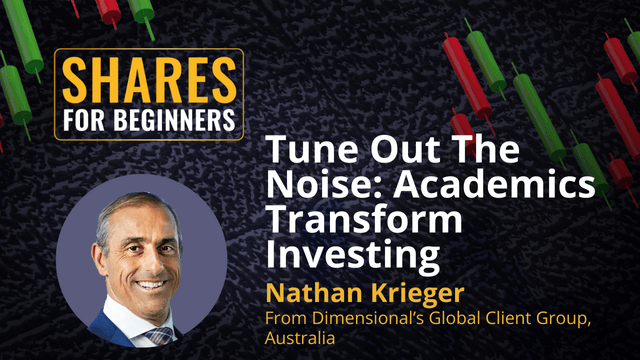

My guest this week is Nathan Krieger, head of Dimensional Fund Advisors' global client group in Australia. We discuss the documentary "Tune Out the Noise," directed by Academy Award winner Errol Morris. The film highlights revolutionary ideas from 1960s University of Chicago academics that challenged Wall Street norms and led to index funds and efficient market theory.
Nathan shares his path into finance, sparked by an inspiring economics teacher and a blend of math and people skills. He joined Dimensional in 2004, drawn to its focus on applying academic insights practically. We explore how the firm emphasizes clear communication amid industry jargon, helping investors grasp concepts without confusion.
A key theme is investing as "the business of dreams." Nathan notes Dimensional manages nearly $90 billion AUD in Australia and $1.4 trillion globally. These funds represent hard-earned savings tied to personal goals like retirement or family security. The film stresses using data to improve outcomes, avoiding futile market predictions.
We trace finance's "Big Bang" to Harry Markowitz's 1952 work on modern portfolio theory, which defined risk and diversification. Before then, investing relied on speculation without data. In the 1960s, computers enabled analysis of decades of market history, revealing most active managers underperformed benchmarks like the S&P 500.
Nathan explains efficient markets: prices reflect all information, making consistent outperformance tough. The film features Nobel laureates Eugene Fama, Myron Scholes, and Robert Merton, plus Dimensional founders David Booth and Rex Sinquefield. They applied research showing small-cap and value stocks offer higher expected returns due to risk premiums.
We touch on human tendencies to spot patterns, like astrology versus astronomy, urging investors to rely on evidence. Nathan praises the film's humor and Errol Morris's style, which humanizes academics like Jeannie Sinquefield, a judo expert and tough mentor.
TRANSCRIPT FOLLOWS AFTER THIS BRIEF MESSAGE
Level up your investing with Sharesight, Investopedia’s #1 portfolio tracker for DIY investors. Track 240,000+ global stocks, crypto, ETFs and funds. Add cash accounts and property to get the full picture of your portfolio – all in one place. Ditch the chaos, track like a pro! Sharesight makes investing easy. Save 4 months on an annual paid plan at THIS LINK
Portfolio tracker Sharesight tracks your trades, shows your true performance, and saves you time and money at tax time. Save 4 months on an annual paid plan at this link
Disclosure: The links provided are affiliate links. I will be paid a commission if you use this link to make a purchase. You will receive a discount by using these links/coupon codes. I only recommend products and services that I use and trust myself or where I have interviewed and/or met the founders and have assured myself that they’re offering something of value.
EPISODE TRANSCRIPT
Nathan Krieger: For folks that are familiar with the Aussie market, they don't trade a lot, and in the US market at the time, they didn't trade a lot. There was no index measuring them. And so the question was, could they actually invest meaningful institutional money in these illiquid securities without being decimated by the costs of doing so?
Phil Muscatello: G' day and welcome back to Shares For Beginners. I'm Phil Muscatello. What are the kind of things that your broker won't ever tell you? And what's the difference between a data dog and a data freak? Joining me today to talk about the cinematic depiction of the Big Bang in finance is Nathan Krieger.
Hello, Nathan.
Nathan Krieger: Hello, Phil.
Phil Muscatello: Nathan Krieger is head of Dimensional's Global Client Group, Australia, and serves in a leadership role on several of the firm's key strategic committees. He's responsible for the strategy and oversight of Dimensional's client business in Australia and New Zealand, leading a team of professionals committed to delivering an outstanding experience to advisors, intermediaries and institutional investors. But today we're here as film critics, Nathan, aren't we? Tell us a bit about yourself and how we got into this role as film intelligentsia.
Nathan Krieger: Film intelligentsia. Um, you may be overstating my role in this one, Phil, but it's a real pleasure to join you today. As you said, my role here is working as the, uh, head of our client group, which works with the investment professionals that Dimensional partner with around the region of Australia and New Zealand. I found myself in this role now for a little over. Well, not this role specifically, but at Dimensional now for a little over 22 years. And having previously had, uh, an interest in investments and finance and worked in a number of other roles, I started out here in about 2004, inspired by some of the ideas that I heard personally when interviewing for the opportunity to start with what was at the time a somewhat fledgling firm in Australia.
Phil Muscatello: So when you're a young bloke, what sort of thing got you interested in this caper? I mean, did you have a family that was interested in investing or did you have any background in that, or just happened into it at university?
Nathan Krieger: Yeah, yeah, it's a good question. I think the thing that really sparked my interest, that led me down this path was a quite an inspiring economics teacher who really, I guess, opened my mind to many, uh, Things economics initially. And following that pursuit as a, you know, as a teenager, it led me to studies of finance at university. I had a pretty strong maths background, so I thought for many years I wanted to be more on an analytical, in an analytical style role, spending time behind a computer and crunching the numbers. But I soon realized that I actually enjoy talking to people as much, if not more. And so for me it was a natural combination of the two, I guess the, or the three actually, the economics and finance, the maths, and then just the engagement and discussion of ideas like these with people that led me to the role that I'm in today.
Phil Muscatello: It's really important, isn't it, to communicate these ideas? Because I think it's. We all know about the finance industry and the amount of jargon that's involved in this industry, and it's really important for ordinary folk via financial advisors, often to actually understand what's going on and have it explained gently. Uh, that'd be the case, wouldn't it?
Nathan Krieger: Absolutely. It's remarkable. I mean, I guess many industries have similar challenges in converting their jargon into ways that most consumers can understand. And financial services is probably one of the best at making things complex. No doubt in many cases they are. But as I'll often say to, uh, folks, you know, we can have some of the best investment solutions in the world, but if people can't understand what they're investing in or understand why, it's a pointless exercise. So the ability to communicate some of these basic ideas and translate them into language that people can understand and I guess make decisions around is a really important aspect, I think, of what we should be doing.
Phil Muscatello: And, uh, we're here to talk about the film Tune out the Noise, which has recently premiered here in Australia. And one of the key things that stood out for me was the idea of being in the business of dreams. That amidst all of this financial jargon and trying to make money and to keep money and to look after money, it's really about people's dreams, isn't it?
Nathan Krieger: Absolutely. I mean, we think often about the fact that every dollar that we are entrusted with to manage on behalf of clients in Australia, you know, that aggregate dollar amount is nearing 90 billion Australian dollars. Globally, that's about 1.4 trillion. That's the money that dimensional manage on behalf of investors around the world. And we can consider that in simple dollar terms, or we can consider that in context of every
00:05:00
Nathan Krieger: effort, every hour that's been, you know, put to the creation of that dollar, all the hard work and toil that many have made to accumulate the wealth that then they entrust to us to manage for them. And as you point out, rightly, it's really critical to m recognize what that means to people. And a dollar is a means of exchange and every one of these dollars has some value ascribed to something that people hope to spend it on at some point in the future. And I think our role is critically important in ensuring that. We're doing our utmost to ensure that people's hopes and dreams and aspirations are achieved, but importantly that amassed saving and wealth that they've created is well managed, is protected, and as I said, delivers on the promise that they can hopefully achieve what they want in life.
Phil Muscatello: Today we're talking about the recently released documentary Tune out the Noise. Directed by Academy Award winner Errol Morris, the film explores the revolutionary ideas from University of Chicago academics in the 60s that challenge traditional Wall street practices, paving the way for index funds, efficient market theory and modern portfolio theory. It draws on interviews with Nobel laureates like Eugene Farmer, Myron Scholes and Robert Merton, as well as dimensional founders David Booth and Rex Sinkfeld. I hope I pronounced that correctly. Having watch the film last weekend. I think it's almost like a grade training for anyone approaching markets to realize that basically no one knows anything. But there was a lot of data and that's what the, the film really looks at is data and how it really changes the way that people think about markets. Whereas in the old days, you know, there was a lot of brokers who would say I can pick stocks that are going to win, but it's a mugs game in the, in the long run, isn't it Nathan?
Nathan Krieger: Yeah, well, it's a real challenge, that's for sure. And I guess what the film tries to convey is that there are, you know, other ways to think about how markets operate. Investing as is life is uncertain. And to know in advance the outcomes of what investment markets will do as just as hard as it is to predict what the future holds is a really difficult thing. I mean, no one truly knows with absolute certainty anything in advance of it occurring. And so I think what the film tries to show is that for many people, where often investing is anchored in some belief that to be successful you need to know the future. Uh, there is an alternative way to think about it and you can have a great investment experience without having to be able to predict markets or predict future. And I think that's what, you know, one of the fundamental tenets of the film tries to convey, as you pointed out with the advent of information, with the progress in this case from financial science, we have more information than we've ever had. And so why not use that information to help inform us how to have a better experience and again, tying it back to the goal, help many people have a better life as a result of their investment experience along the way.
Phil Muscatello: So we're looking at a time here when it was the first time that academics actually got together and decided, well, let's actually look at the data, because no one had looked at the data before and they were using many decades of market history that they were plugging into what were then known as computers, these brand new things as well, which allowed for the crunching of all these numbers. Just tell us a little bit about that process and how it really changed the thinking of people and investment professionals.
Nathan Krieger: It's a really interesting one, Phil. And as I said, one of the things that piqued my interest in my career and through my journey to be involved in Dimensional and the work that I do today was the intrigue that I had in understanding how this business took some of these ideas and these learnings from academia into practice. And at the time that you're referencing in the advent of increased amount of information, data and computers in the 60s and 70s that are allowing at the time universities to do analysis and actually test theories, run hypotheses and check if they held given the data, um, it was a real revelationary point in time. As said, I found it quite inspiring when I started talking with Dimensional in the early 2000s as I investigated the company for my own career. But at the time that the film documents in that period, it must have been an incredibly remarkable time for those people involved because as you said before then, it was very speculatory. There was no, you know, broad scale indices like we, we reference today. There were, the concepts of benchmarks were not well understood if not even documented at that point. And you know, just the sum of the things that we take naturally for granted in today's modern day just, just didn't exist. So it was all very exciting.
00:10:00
Nathan Krieger: As I said, theories will be able to, were able to be put forward and tested. And I think then it was very clear that, you know, what people understood prior to that point in time had some real pitfalls, to say the least. And it started to open up the opportunities to think about things a different way. And one of the big data discoveries at the time was then the ability to assess the performance of professional money managers, which again, prior to the work, uh, this case it was by Michael Jensen. Prior to that work in the 60s, there hadn't been, you know, a comprehensive assessment. And it showed that most professional money managers had very little success beating the broad market after fees. Obviously that's a, uh, complete opposite to the proposition of many. So it was a. Was quite revealing at the time. And as I said, the data enabled, you know, people to test things and the computing power that was available at that time was a big step up from what had been available previously, allowing these sort of analyses to be done.
Phil Muscatello: Track your investments like a pro. Sharesite is Investopedia's number one portfolio tracker for DIY investors. Simplifying your finances. Get four months free on an annual premium plan@sharesite.com sharesforbeginners.
Philip Lewis: The film focuses on the development of portfolio theory in 1952
So you were talking about indices then. And one of the things that came out was that if people had invested in The S&P 500, for example, they would have outperformed most of the active money managers and stock pickers of the time. Was there a concept of the S&P 500 at that stage?
Nathan Krieger: I think people understood investing in the market. I think you'll have to bear with my average recollection as to when the S and P was first produced and made available at the time. But certainly the concept of any benchmarking was not the norm. If you had some money, you would often take it to a broker who would invest it, usually in specific stocks, which is another point worth referencing. And the data and the analysis that was undertaken in the universities at the time. And often people credit Harry Markowitz as being the father of modern portfolio theory. But what he discovered in the 50s, I think it was first documented, was that you could actually reduce the risk and you actually had a model to understand risk, which hadn't been done previously, but you could modify your risk by having more than just a few securities, by diversifying effectively, which again, is a tenant. We understand. Well, now, again, if you consider the question that you asked in terms of what people were looking at, what they were doing before, was there a benchmark? I mean, beforehand people thought, again, take money to a broker and they would invest it for me to get a better return. It was very singular, it was very stock oriented. With Markowitz discovery, it was a recognition that we could think about things in portfolio terms rather than just individual stocks. And to your question, with the advent of reference to indices and benchmarks, people within test, how well am I actually doing? Is 10% a good return or is 10% actually not a great return? If the market's doing 20 and those sort of relativities are really important to understand.
Phil Muscatello: Is that the big bang of finance in 1952 that you're referencing there with.
Nathan Krieger: Harry Markowitz, I think you can definitely refer to it, that the film definitely highlights it as that. And it was really a critical discovery, if you like, or documentation of our understanding of how financial markets work. And as I said, the first effort to describe risk in a way that was able to then be built upon in a somewhat systematic manner in a way that allowed the science to progress further with a baseline for sure.
Phil Muscatello: Because prior to this, the idea of risk didn't really exist, did it? I mean, there is risk in terms of every investment. When I talk to investment professionals, there's certain levels of risk for certain kinds of products and certain kind of companies and certain sites, certain kinds of asset classes and so forth. Um, really is the idea of a fully functioning and operating portfolio really was revolution. Where it sounds kind of almost mundane these days.
Nathan Krieger: Absolutely. Look, uh, I think I'm guessing, and I wasn't around in those days, but I'm guessing people understood risk to some extent just through the nature of life in general. And then translating into risk and buying a stock, is it going to succeed or not? Perhaps understanding that, but codifying it and putting it in a form that helped describe it in a way that we could, you know, understand and use. I don't think anything existed, as you point out before then.
Phil Muscatello: And it's a real cinematic experience, this film. I mean, Errol Morris, as I mentioned, he's an Academy Award winning documentary maker and I also looked up to do a bit of research on him. And he invented the interrotron, which apparently is a way of interviewing people. It's this bit of hardware which didn't exist before him. But yeah, the film itself is
00:15:00
Phil Muscatello: actually really nicely done. And I think what comes across is the gentle humor of the academics involved. Did you have any thoughts on that?
Nathan Krieger: Yeah, it's a couple of points I'd make in relation to that, Phil. I think we were very fortunate to be able to work with Errol Morris. His quality of production is remarkable. And now having seen the film on more than 2, 3, 4, 5 occasions, it still is enjoyable to watch. From its cinematic appeal to, I think. So I hope for those viewers that decide to watch it in time that they'll enjoy it as much for that reason. But definitely his techniques draw out the human on the other side of the camera very well. The actual, I guess, grounded base that most of the folks that he's interviewing have come from and their journeys, which, as I said, for me, I found it incredibly intriguing being the kid that was interested in finance, economics, math. I thought it was awesome, and I think it does a really good job. I've worked for dimensional now 20 plus years and had the great fortune of meeting many of the people in the film in person. And I can say categorically, the film does a wonderful job of showing, you know, who they are as people very well. And unfortunately, some of them aren't here today. So I think it's awesome that we've been able to capture some of their perspectives in a film like this.
Ken French talks about people's natural tendency to see patterns in markets
Phil Muscatello: So tell us about Kenneth French and his ideas around people's tendencies to see patterns in markets.
Nathan Krieger: I love that one. I love that one. He says it way better than I will, Phil. But let me try and draw from my understanding and I guess, engagement with Ken over many years. He talks about the natural tendency for people to see patterns in anything. And I'll draw a parallel for myself in that I. I'm a surfer. I know you're up on the coast as well. So potentially you're familiar with this yourself, and maybe some of your listeners are. But if you're in the water and you see a dark shape swimming past you really quickly, you're more inclined to think that there could be a shark there. And natural reaction might be to respond as if there is one, and get out of the water. You're likely to sit. Now, it could very well be that it was a cloud passing by and you saw something that you thought was a shark, but it wasn't. The natural tendency, though, is for humans in general to see those sort of things and react to them. And whether it's a situation in a fun setting like surfing or if it's actually in markets, I think the same human response exists. So we often will see investor behavior that's in response to patterns, and they could be correct or incorrect. And the fact is that we see investors behave time and time again in response to these patterns. Unfortunately, sometimes that can be to their detriment. So I think one of the points that Ken makes there is that it's really important to recognize that we're hardwired to see patterns even when they may not be there. And it's important to understand, you know, what are the, you know, the primary, you know, tenants that we should be focused upon to have a successful investment experience. And that really comes back to drawing from some of the things we've learned through financial science.
Phil Muscatello: And that's really the idea of the financial science that they espoused is that we've got to overcome these natural tendencies as humans that we're hardwired to engage in.
Nathan Krieger: Yeah, yeah, we are. And you've seen it, I'm sure, and I'm sure many of the folks listening have felt it and seen it themselves. But humans, when it comes to financial markets, there's a real tendency to respond to things on the basis of fear or on the flip side. And agreed. And we see market behavior, we see investor behavior naturally responding to these, just the natural human tendencies. So sort of like a self awareness is a really valuable element to have when it comes to really distilling what's important and perhaps what we should not respond to at certain points in time.
David Booth helped create the first index fund via Wells Fargo in 1970s
Phil Muscatello: So tell us about the team's involvement with the first indexed fund. It wasn't an ETF at that stage, but it was an index fund via, um, Wells Fargo, I believe.
Nathan Krieger: Yeah, yeah, it's a really cool story and I've heard it, ah, thankfully a number of times. But David Booth was recruited to be part of a team at Wells Fargo that were able to actually create the first index fund as sort of a subunit. They were called the Management Sciences Unit. From recollection sponsored by the chairman, they were able to come up with a way to run a portfolio. Drawing from what he had learned as a student. He was a student of Gene Farmer. Gene Farmer is one of the other big contributors to finance theory over the years. He's well known for his efficient market theory that says that security prices have a lot of information and in fact have most of the information available or all public information available impounded in their prices
00:20:00
Nathan Krieger: every single day, every single second. It's very difficult to outguess and therefore stocks follow a random walk. It's very impossible basically to predict what the future price of a stock will be knowing with the information that you have about the stock today. That's his theory again. He won the Nobel Prize for that in 2013. And anyway, David had been a student of Gene's and was fortunate to work in this Management Sciences unit where under Mac McWellan, another one of the contributors in the film that uh, you'll hear and one of the founding directors at Dimensional, he was, he was able to create this first index fund and when they were able to actually turn the theory into practice, and that was, that was kind of the first time that theory had been put to practice. And they learned a lot of things in doing that. They learned a lot of things about the importance of implementation, which is something now that dimensional 40, um, or almost 45 years into our history, takes a lot of pride in and highlights that it's really critical when it comes to translating a theory into practice. Because in the real world there are trading costs, there are taxes, there are cash flows, there is investors that are wanting their money and investors that are adding money. So there's real world issues to manage assets and do it well that need to be accounted for that in theory, in an academic paper, not, uh, necessarily taken into account. And so to your question, it was really cool at the time, in the early 70s when David first worked on that index fund and first developed it for that particular unit. But it was all a little bit of a, um, you know, a project within a larger organization. It didn't actually take big legs or big steps forward at that point in time.
Phil Muscatello: And subsequent to that the idea was taken by Jack Bogle from Vanguard, who's often credited as being the inventor of the ETF. But he didn't actually like ETFs, did he? He much preferred an index fund.
Nathan Krieger: I think that's exactly right. Obviously Jack has been a huge contributor to, if you like, the democratization of investment for many people around the world. And I think the prevalence of index funds has helped a lot of people. The story of Jack getting the opportunity to learn from David and Max work and actually turn that into the company that is Vanguard today, or turn those ideas into practice to create the company that is Vanguard today is remarkable. And yeah, there's a really cool part in the film where Mac, uh, McQueown is telling that story about Jack, uh, being given, if you like, the recipe to the index fund, uh, and to think that, you know, Vanguard now, I think the largest or the second largest asset manager in the world, mega size, multiple trillions of dollars that they are entrusted with from investors around the world. It's quite remarkable. So it's cool. And I think the, the story itself of that just tells a little bit again about the kind of people that are in this film, the humility that they had and the openness to these ideas. We often talk about a dimensional. The ideas are bigger than the firm itself. These ideas are available for everyone. And I think that example highlights straight away, you know, the way that this group of people were willing to share what they were learning, as I said, with a goal to help more people.
The film tackles how small cap stocks outperform the S&P 500
Phil Muscatello: Another part uh, that the film tackles is in regards to small cap stocks and how they outperform the S&P 500. Tell us about that. And how they discovered it and what it actually means for people's investing.
Nathan Krieger: Yeah, if you want to go to the small cap, it really does start to talk about the further definition of risk, uh, as we draw, you know, improved understanding of how markets work. And there were some big contributors to that, obviously. Robert Merton was one in particular that helped to highlight that the capital asset pricing model or the work that Markowitz and Bill Sharp before had done didn't adequately describe everything, didn't adequately describe risk, and that there might be some other way to help us understand risk. The idea of small caps having a different risk, I guess today, probably seems somewhat intuitive. And I'll give you an example. If you were to think about an investment in a large company versus a small company, and if we assume everything else is equal, the same line of business, the same sort of products and services, but one's just operating a much smaller level, perhaps there's only a few, you know, operations. If we take a supermarket, for example, you could take a large national chain versus a, um, small, you know, grocery operation in one town. And if you consider, you know, and from an investor standpoint, the offer to lend money to that business is certainly the bigger business. You feel that there's, you know, far more certainty, far more confidence that you're going to get,
00:25:00
Nathan Krieger: you know, your money back and a, uh, return from it than a small one. It's going to invariably carry more risk. It's only got one small operation versus a large national operation. So the idea intuitively that smaller companies are riskier than large, I don't think is too outrageous for most people. But what we found in the academic literature in the late 80s was that it was actually documented. And people started to be able to see that these small cap companies actually looked a little different in terms of their behavior too. They had often a little different volatility to market. And the idea there was that by investing in companies that have greater variability or volatility, then an investor should be rewarded for embracing that. If you like uncertainty that is evident through that variance of volatility that actually led to the start of Dimensional. Phil and that was the key piece of research that David Booth and in time, Rex Singfield, the co founder of Dimensional, took, uh, to investors around America. They recognize that these large institutions at the time had well organized portfolios of large cap companies, but very poorly organized small cap exposure, and often not even having any small cap exposure at all. And so the theory, without any products, was to educate these big institutions, say, well, we can improve the portfolio result Again, drawing on a lot of the theory, even back to Markowitz saying diversification helps because these group of securities don't behave like the portfolio you have. Uh, they are going to operate differently. That diversification that they bring will improve the end goal that you're trying to achieve. It'll lower the overall portfolio volatility, minimize the ups, the downs, and ideally improve the returns. Because these companies should deliver you an improved return given they're smaller. And if you ascribe to that intuitive notion I said before, these smaller companies should carry a higher risk and therefore reward investors for that. So that, I think is a really pivotal point in time. And it's a really nice story when you look at it from the lens of both the theory and certainly as it relates to the start of Dimensional as an organization.
Phil Musatello: Are you confused about how to invest? LifeSherpa can ease the burden of having to decide for yourself. Head to lifesherpa.com to find out more. LifeSherpa, Australia's most affordable online financial advice.
Phil Muscatello: So tell us, how did it lead to the creation of Dimensional?
Nathan Krieger: Well, I mean, literally, David and Rex took these ideas from the halls of academia that they had studied at and took the ideas to those that they felt would benefit from it. Both of them had been working in the financial services world, you know, looking at, you know, consulting to these larger institutional clients. And it's awesome when you hear some of the stories about the trust that was placed on them. But they showed, you know, the theory, it made good sense to those investment professionals they spoke with. And thankfully for them and us today, there were a number that were willing to trust them and allow them to take, you know, I guess, some of their client portfolios or some of their portfolios and invest them that way. And the learnings that David, uh, had taken from the implementation of that index fund way back in the earlier part of the 70s were really critical here because some of the objections to being able to invest in small companies came from even very notable other academics like Myron Scholes, again, who has a Nobel Prize for his work, the Black Scholes options pricing model. And Myron says himself he was very skeptical of the ability to invest in these small and often microcab companies because the cost of investing in them were just so high. These are companies that, you know, for, for folks that are familiar with the Aussie market, they don't trade a lot. And in the US market at the time, they didn't trade a lot. There was no index measuring them. And so the question was, could they actually invest meaningful institutional money in these illiquid securities without being decimated by the costs of doing so. Thankfully, they proved Myron wrong over time. But some of those lessons, and I touched on it a little earlier, that really emphasize the importance of implementation. One thing is things are great in theory, but it's really critical you can take that theory into practice. And I think those first years of dimensional investing, these small and micro cap portfolios for institutions in the United States demonstrated that they were able to actually implement effectively in the real world, despite the challenges of doing so.
Dimensional research group are definitely in the bucket of the data freaks
Phil Muscatello: So what is the difference between a data freak and a data dog that they mention in the film?
Nathan Krieger: I think Jeannie Sinkfield says it way better than I, but I think the data freak really loves it. They really love digging into the data. They think it's fun. I think all of us at Dimensional really like the data. There's no doubt, and there's some that like the data even more than others. One thing's for sure, that whenever we're looking at any aspects to incorporate into investor portfolios and wind the clock forward 45 years now, from those initial microcap portfolios to what we know today, which is, you know, miles ahead of what we knew then, it's always important to check that it, uh, it stacks up in the data. And you'll hear our research team now interrogating academic work or their own to see if they can find, you know, the cadavers, so to speak. Are there any, any clues here as to why this doesn't actually hold? They're, uh, they're approaching things from a skeptical standpoint. So I'd say the dimensional research group are definitely in the bucket of the data freaks. They love it.
Phil Muscatello: And Jenny's quite a character, isn't she?
Nathan Krieger: Absolutely, she certainly is. I actually remember meeting her for first time. I think it was on my own, uh, uh, my first trip to the States. And yeah, she really had a way of testing your knowledge. And I wasn't put through some of the same sort of grillings that my colleagues actually managing the money have been put through, but she was certainly very keen to ensure that the folks working at Dimensional knew what we were talking about. I think she was actually quite good about it because the, uh, intent was there. It was, we want to make sure that you know what this is all about and you're representing it well. And at the end of the day, the mission of the business has always been and showed through the film, try and help people get a better result. How do we help them? And we're going to help them by telling them, you know, the things that we know that hopefully are going to help them in time. So yeah, Jenny is very good at making sure that we knew what we were talking about.
Phil Muscatello: Yeah, I think she's one of the highlights of the film for me personally, and very funny, but obviously, uh, her frightening demeanor.
Nathan Krieger: Sorry, yeah, yeah, I was gonna say, notwithstanding her judo prowess, that's touched on in the film as well, Phil.
Value stocks tend to outperform growth stocks over time, according to film
Phil Muscatello: So one of the points that the film makes is that value stocks tend to outperform growth stocks over time. Tell us about that. I mean, that sounds a little bit counterintuitive as well, but obviously they've got the data that shows this.
Nathan Krieger: Yeah, look, I mean, the interesting thing about values. So, uh, there's a couple of points to make in sort of a theoretical term and then I'll talk about it as it translates into practice. But you know, you can even ascribe, you know, value investing back to the great like Buffett and his mentor Benjamin Graham, who wrote about this, you know, in the early 1900s, I think it was 1920s, maybe 1930s. The intelligent investor. So the concept of buying something at a discount to achieve a better result, I think it was something that had, you know, investors at least, and those successful had been able to identify as a way to improve investor outcomes. Now, Ken French, who is a longtime collaborator with Professor Eugene Farmer, documented this value effect in an extension of, I guess the model that was used to, to categorize risk. Now we're getting a bit technical here, but the cross section of expected stock returns was the paper the two of them co wrote published in 1992. And what that showed in an academic and empirical way was that value stocks, as you highlighted, Phil, have a higher expected return and in fact a d higher historical returns than growth stocks. And a way to think about this intuitively is, is as simple as this is. If you can buy the same asset at a lower price, you know, over time you'll expect to get a better return. And, and you can think of that simply the analogy of two houses. Let's say two houses on the same street, two houses on the same street of the same build of the same year, in the same condition, maybe with the same rental. Okay, let's say they're million dollar houses with a $1,000 a, you know, week rental and they both are, uh, for sale. But one, for various reasons has to be sold a little cheaper than the other. Perhaps the sellers need to get rid of it. Perhaps they're in a hurry. Perhaps the market's been soft, I don't know, but one of them goes for 950, the other one's a million. It's natural to understand that, you know, if the cash flows, that is rent from that house are, uh, the same in both houses, but the price that you've paid for it is less than the value of a million at 950, the return to you as an investor is higher. So that's the simple notion of value
00:35:00
Nathan Krieger: investing. And as I said, it was codified in academic terms through that paper in 1992. And dimensional, as we move with our understanding of financial science, has applied that to the way in which we've built investment strategies. And again, the film talks really nicely, I think about that big step forward because it certainly expanded things from just small caps and broad indices. And all this is starting to sort of show that these evolutions or breakthroughs in financial science help investors deliver, uh, to themselves, great results over time. If you can understand some of these basics, we hope that you'll have a better outcome over time.
Phil Muscatello: Well, for me that's one of the great things about the film. Understanding some of these parameters in which the finance industry has been described and codified really can help you understand as an individual investor what's actually required. Not the idea that you're going to pick up a tip from your mate at the pub and suddenly have life changing results, uh, coming out of that.
Nathan Krieger: Yeah, yeah, well, I mean we've all, we've all heard the tips, but I think the, the reality is, look, there's a lot more that we know. Why not use the information we know? It's akin to, I think, any other, you know, science or profession that, you know, you want to keep improving, you know, what we do based on an improved understanding of how things work. And the film does another, a little funny example against, uh, you know, uh, astrology versus astronomy. And obviously, if you think back to civilizations well before us, their explanation and understanding of the galaxies around them was far more simplistic than ours today, with incredible telescopes available and our understanding of all of the physics that we think underpins the way that our, uh, universe operates. So it's behoven on all of us to take that understanding and apply it to how we think about the world and in this case how we invest.
Phil Muscatello: And you can also use that idea, uh, of astrology as being an example of pattern making as well, can't you, that we're always looking for patterns in the sky.
Nathan Krieger: We can see some personally.
Phil Muscatello: Oh yeah, yeah.
For you Personally, were there any favorite, particular favorite parts of the film
For you Personally, were there any favorite, particular favorite parts of the film?
Nathan Krieger: Look, you touched on one a little bit earlier, which was the uh, sort of the hopes and dreams that Senator Bill Bradley touches on. Uh, and Senator Bradley has again been one of those other phenomenal people that we've had the opportunity to interact with. If you look at his cv, it's really, it's remarkable. He's got more on his accomplishments than most human beings. Well, you know, you could probably put 12 to 20 human beings in a room and all of high performance and they're probably not going to have a CV that's quite like his. But he does talk about the profession of advice being one that's so close to the hopes and dreams of people. And it's remarkable to me because I think that is one of the central things that really motivates me and many of us, you know, at Dimensional is that, you know, we are responsible for ensuring that people have the opportunities in life. Everyone wants to improve their life, their lot in life and you know, it's a big responsibility. And financial advice has an incredible opportunity to help people connect that hope, that dream, that aspiration, uh, into, into a, turn it into a plan and obviously through one part of the plan being investing, help people achieve that. There are other things that financial advisors and financial advice delivers beyond investments. In fact, I think many of the folks that I've had the privilege to work with over many years, you know, demonstrate that sometimes that's just another ear or another set of eyes. But the thing in the film where Senator Bradley talks about that to me really hit home. And again it sort of puts the whole purpose behind all of this because uh, whilst that kid 20 odd years ago was intrigued by the financial science, the guy now sitting behind the mic is motivated by what impact it has. And I think that's to me where it really, really comes together.
Nathan Krieger discusses lack of qualified financial advisors in Australia
Phil Muscatello: You would be dealing with financial advisors and the financial advice industry on a daily basis, I presume. How are you finding the challenges? I know we've gone a little bit off topic here from the film, but how are you finding the challenges and um, what seems to be a lack of qualified advisors in Australia at the moment.
Nathan Krieger: It's really interesting Phil. The last five years has seen more change in financial advice than I've ever seen in my time. 30 odd years, 35 almost now in financial services. The challenge was well and truly put to financial advice five, 10 years ago. And I think, to be frank, thankfully things have changed dramatically for the good. There's been a uh, real Improvement in, I guess, the qualifications and the capabilities of advice as it's been given, the understanding I think, that people have that advice can give them is
00:40:00
Nathan Krieger: improving. I think like anything, if you, you know, you have someone else by your side helping you think about the challenge, whether it's a, you know, fitness coach, you know, someone that can help nudge you to lift the knee up a little higher or, you know, uh, pick up the weight, you know, that way, or whatever it is, you know, stretch the arm out a little more. I think financial advice can play that role, and I think people recognize that can be helpful even if they are well informed. And I would not suggest not informing yourself. That is absolutely number one. But I think advice, people recognize that advice can help them. The world is continually complicated. It's not going to get any more simple. There's information flying around everywhere. So I think good professional advice in any part of what we do can be valuable, uh, part of what we do in life. And I think financial advice in Australia has really gone through an evolution in the last five years. And there's some really quality practitioners out there that are, uh, focused truly on delivering great outcomes for their clients. And I've no doubt that those clients are better off as a result of it. And I'm confident that for those seeking a career in advice, there's incredible opportunities. As I said, it's a noble profession and you can really help people and have a good life yourself in doing so. That's a pretty nice place to be, I think.
Phil Muscatello: So. The film Tune out the Noise, it's available on YouTube. We'll put a link in the episode description in the notes and the blog post so, uh, people can have a look at it. And again, I would highly recommend it. Is there anything else that you'd like to say to recommend it? As our resident film critic at Dimensional.
Nathan Krieger: I'm not sure I'm going to be asked back to critique any more films, Phil, but I appreciate the opportunity, opportunity to share my perspectives on this one. Look, I think it's a wonderful documentary. I believe it does a great job in helping inform people that take the time to view it on some basics that will help you have a different perspective and hopefully help your experience investing, whether or not you choose to use an advisor. Our goal has been to share some of the ideas that we think have been profound in our understanding of markets and profound in the way in which people can achieve better outcomes than what perhaps their predisposition to investing might be before understanding those things.
Phil Muscatello: Yeah, I think we could. Nathan Krieger, thank you very much for joining me today. It's been a real pleasure chatting with you.
Nathan Krieger: I've enjoyed it too, Phil. Thank you very much.
Phil Musatello: Uh, thanks for listening to Shares for Beginners. You can find more at sharesforbeginners. Com. If you enjoy listening, please take a moment to rate or review in your podcast player or tell a friend who might want to learn more about investing for their future.
00:43:10
Any advice in this blog post is general financial advice only and does not take into account your objectives, financial situation or needs. Because of that, you should consider if the advice is appropriate to you and your needs before acting on the information. If you do choose to buy a financial product read the PDS and TMD and obtain appropriate financial advice tailored to your needs. Finpods Pty Ltd & Philip Muscatello are authorised representatives of MoneySherpa Pty Ltd which holds financial services licence 451289. Here's a link to our Financial Services Guide.